Abstract
Eleven technology verticals
- arrow_rightArtificial intelligence: target recognition, predictive maintenance, wargaming and decision support.
- arrow_rightAutonomous systems: ground, underwater and surface vehicles for logistics, mine countermeasures and patrol.
- arrow_rightUAV/UCAV and loitering munitions, from high-altitude ISR to swarms and precision strike.
- arrow_rightCounter-drone: hard-kill (directed energy, air-burst, interceptor drones) and soft-kill (RF jamming, GNSS spoofing).
- arrow_rightElectronic warfare: spectrum monitoring, radar warning, direction finding and jamming.
- arrow_rightCyber defence of command nodes, energy grids and transport.
- arrow_rightSpace: earth observation, SAR, secure SATCOM and space situational awareness.
- arrow_rightQuantum: key distribution, sensing and post-quantum cryptography.
- arrow_rightMilitary robotics: exoskeletons, EOD robots and high-altitude mule robots.
- arrow_rightAdvanced sensors: AESA radars, EO/IR payloads and acoustic seabed arrays.
- arrow_rightBattlefield communication: software-defined radios, tactical data links and mesh networks.
Startups and dual-use innovation
Through iDEX (Innovations for Defence Excellence) and the Technology Development Fund, startups and academic labs shorten prototype cycles and adapt commercial technology for harsh military conditions.
What the record shows
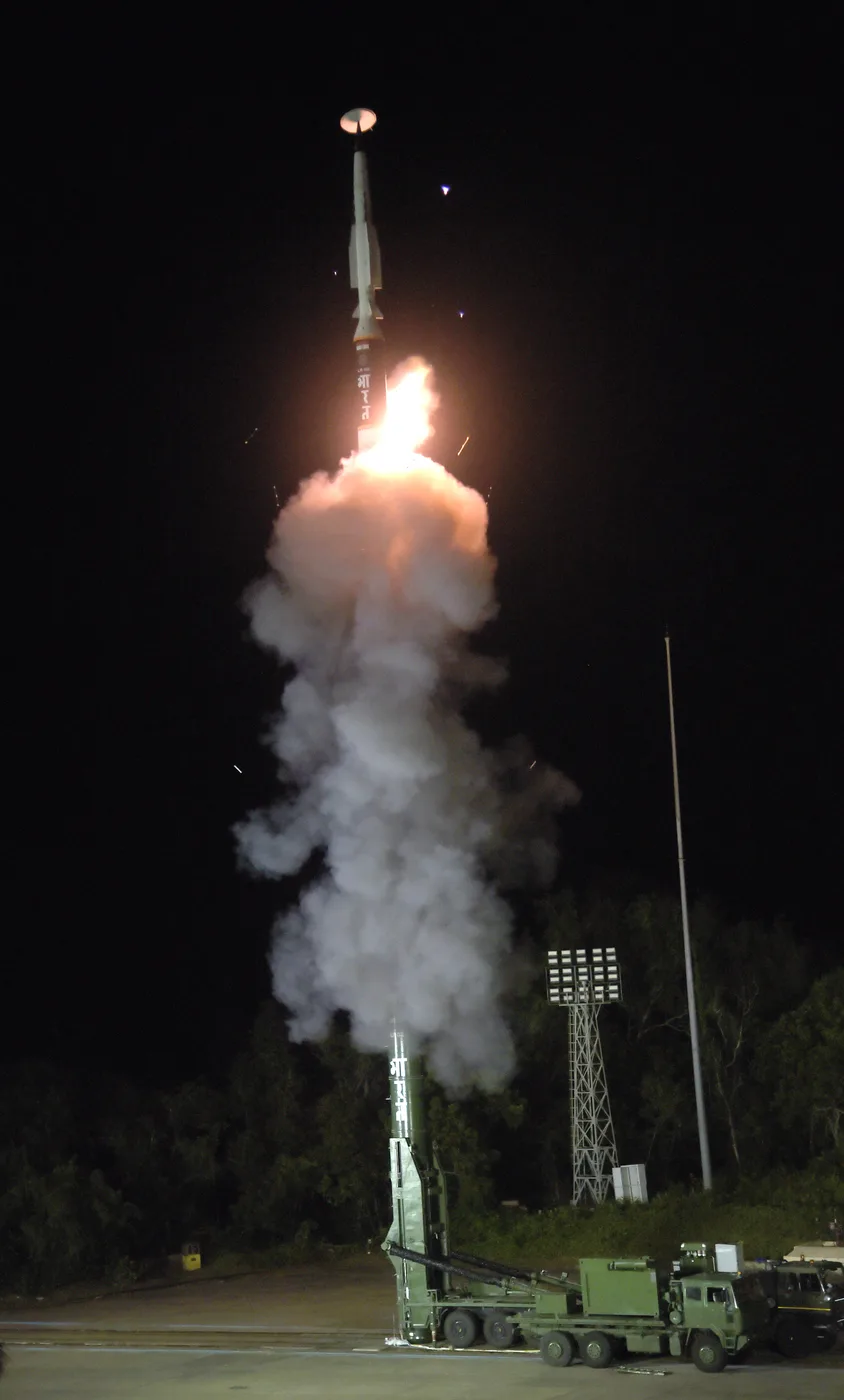
Official record: DRDO flight-tested India's first long-range hypersonic missile from Dr APJ Abdul Kalam Island; it is designed to carry various payloads beyond 1,500 km for all three Services.
Defence Observer synthesis: Hypersonic glide capability compresses an adversary's air-defence decision time on both continental and maritime fronts.
Official record: DRDO completed flight tests of the Guided Pinaka in three phases at different ranges, validating range, accuracy and production readiness with industry partners.
Defence Observer synthesis: Guiding Pinaka turns an area-saturation rocket system into a precision counter-battery tool for Corps and Division commanders.
Official record: DRDO conducted the maiden flight-test of the Long Range Land Attack Cruise Missile from the Integrated Test Range off Odisha; all sub-systems met their primary objectives.
Defence Observer synthesis: A common subsonic cruise missile for mobile launchers and naval vertical launch cells gives a scalable long-range conventional strike reserve.
Assessment
- arrow_rightIndigenous hypersonic, guided-rocket and cruise-missile programmes widen India's conventional stand-off options.
- arrow_rightThese systems are most useful when integrated into tri-service theatre structures.
- arrow_rightiDEX and dual-use innovation are now part of how capability is built.
Sources & citation
- DRDO and iDEX public technology domains and problem statements
- Press Information Bureau, Ministry of Defence: PIB release 2073994 (opens in a new tab)
- Press Information Bureau, Ministry of Defence: PIB release 2073384 (opens in a new tab)
- Press Information Bureau, Ministry of Defence: PIB release 2072829 (opens in a new tab)
Cite this paper
Defence Observer Strategic Research Centre (2026). Next War & Emerging Technologies: AI, Autonomous UAV/UCAVs, Counter-Drone, Electronic Warfare, Cyber & Space. Defence Observer, PRGI Reg. No. DLBIL/26/A7836.